
When is pasta done?
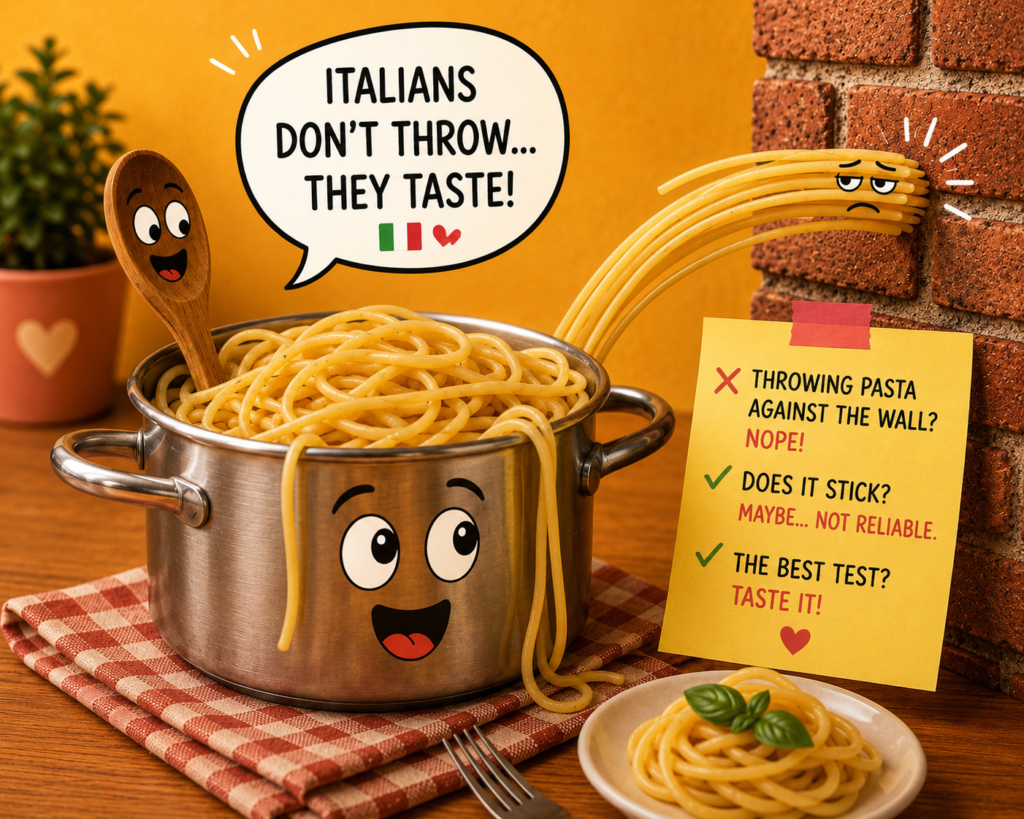
Finally, you’re allowed to throw food! Or… maybe not?
Everyone knows the “trick” of throwing spaghetti against the wall to check if it’s cooked. But does it actually work?
All over the world, there are aspiring chefs throwing strands of pasta at the wall. Except in Italy. There, they simply taste it.
At first glance, the test seems logical. We start with dry pasta that doesn’t stick together, and end with cooked pasta that quickly turns into one sticky mess if you’re not careful. Conclusion: uncooked pasta doesn’t stick, cooked pasta does.
That observation is correct and gives a possible explanation, but there’s no real scientific foundation behind the famous pasta-against-the-wall test.
German researchers decided to put the test to the test. They used standard spaghetti from the well-known brand Barilla, with a recommended cooking time of 9 minutes. After 3, 6, and 9 minutes, thirteen volunteers threw spaghetti strands against a kitchen wall, a window, and a blackboard. That resulted in 13 × 3 × 3 = 107 spaghetti throws, all judged by whether the pasta “stuck” or “didn’t stick.”
At first, the results looked promising. The spaghetti did stick more often the longer it had cooked. After 9 minutes, almost every strand stayed stuck to the wall — exactly as the pasta-throwing test predicts.
Unfortunately, the spaghetti also stuck to the wall after only 3 and 6 minutes. In more than half of the cases, in fact, with an error margin of 30%.
For those who prefer cooking over statistics: this basically means you’d need to throw quite a lot of spaghetti at your wall before you can be truly sure it’s done.
You could compensate for the spaghetti loss by peeling the strands off the wall and serving them anyway… but by then you could also have simply tasted the pasta or trusted the recommended cooking time.
And then there’s still the question: what about overcooked spaghetti?
The German researchers concluded that we should do what Italians do best: TASTE IT.
According to the researchers, the study also had a bigger purpose: to show that we shouldn’t blindly believe commonly accepted “facts,” and that science exists to protect us from nonsense and misinformation — even when it comes to flying spaghetti strands.
Source: Eos Magazine, issue 12, December 2016.